service DESIGN + AI
Shaping Digital Sovereignty in Germany
This case study is currently in rollout.
ROLE
UX Designer
UX Designer
UX Designer
EXPERTISE
UX / AI Design
UX / AI Design
UX / AI Design
YEAR
2025 – 2026
2025 – 2026
2025 – 2026
problem
state
Curating AI solutions
for the Public Sector in Germany sounds challenging.
That's where the fun is.
Bureaucracy takes time. So do good case studies.
When we think of public sector software, we usually picture clunky interfaces, endless compliance PDFs, and systems that feel stuck in the early 2000s. Not a win.
Yet as part of the Strategic Frontrunner Projects team at SAP, thirty of us were handed a different mission. Working alongside federal ministries, we developed rapid AI proof-of-concepts designed to modernize fragmented government workflows across state, federal, and local systems. Rapid iteration and rapid rollout. Our goal was to break down the massive fragmentation between state, federal, and local systems, building scalable proof-of-concepts that reduce administrative workloads significantly. And in time, one use case in the pipeline turned into six.
Come back soon for the full design process behind the project.

During these projects, my role as a UX designer spanned multiple disciplines, from crafting a cohesive service design concept, establishing brand design systems, to building UX/UI layouts. This comprehensive process resulted in a strong, unified brand identity leading to positive feedback from over 87% of users in post-launch surveys measuring brand appeal.
As part of the Strategic Frontrunner Team at SAP, we didn’t think in terms of rigid, multi-year enterprise cycles. Our task was to serve as an agile spearhead, developing groundbreaking proof-of-concepts (PoCs) for ministries and the public sector—and to do so in record time. Initiated by the Federal Ministry of Digital and Transport (BMDV), our goal was to break down the deep fragmentation between the federal government, states, and municipalities.
problem
Curating AI solutions
for the Public Sector in Germany sounds challenging.
That's where the fun is.
Too many Berliners struggle to find consistent, high-quality beauty services due to a lack of transparency, communication, and reliability. Wellfaced bridges this gap by connecting talented freelance beauticians to quality-seeking wellness enthusiasts.
Connecting talented freelance beauticians to quality-seeking wellness enthusiasts is what wellfaced is all about. This project focused on crafting a strong brand identity and cohesive design system, ensuring wellfaced reflects trust, quality, and accessibility at every touchpoint.
Access Study
solution
solution
Wellfaced's Brand Presence.
Wellfaced's Brand Presence.
Connect to Content
Add layers or components to infinitely loop on your page.
Access wellfaced Brand Book
Connect to Content
Add layers or components to infinitely loop on your page.
research
Why it works: Wellfaced Transforms Premium Beauty Services to be Accessible and Trustworthy.
With wellfaced, I designed a brand experience that reflects trust, luxury, and emotional connection. The research phase wasn’t just about gathering data; it was about listening.
By engaging with users through multiple research rounds including think-aloud protocols, journey mapping, and system usability scores, I unearthed the nuances of how individuals navigate the beauty booking experience. Every insight gathered—from the hesitation caused by overly complex navigation to the delight sparked by intuitive interactions and aesthetics—became a guiding thread in the tapestry of wellfaced’s brand and UI design.
Ultimately, I uncovered a key tension: users seek safe, fulfilling experiences, but also demand a service understanding that conveys expertise and trustworthiness—hallmarks of a premium brand.
From tackling the problem at the root of the issue, to fostering a complete brand identity along with a dev-ready mobile design, the following phases illustrate the backbone curation of my personal project wellfaced.
Connect to Content
Add layers or components to infinitely loop on your page.
During these projects, my role as a UX designer spanned multiple disciplines, from crafting a cohesive service design concept, establishing brand design systems, to building UX/UI layouts. This comprehensive process resulted in a strong, unified brand identity leading to positive feedback from over 87% of users in post-launch surveys measuring brand appeal.
As part of the Strategic Frontrunner Team at SAP, we didn’t think in terms of rigid, multi-year enterprise cycles. Our task was to serve as an agile spearhead, developing groundbreaking proof-of-concepts (PoCs) for ministries and the public sector—and to do so in record time. Initiated by the Federal Ministry of Digital and Transport (BMDV), our goal was to break down the deep fragmentation between the federal government, states, and municipalities.
Connect to Content
Add layers or components to infinitely loop on your page.
Preparing…
Preparing…
Preparing…
My research journey began by crafting user personas and mapping out user journeys gathered from primary research.
Over the course of the project, I gathered 32 participants – including artists and clients – to aid in my investigation. Consequently, my users' service needs was crucial; acting as the backbone to the central user flow shaping the brand experience.
Connect to Content
Add layers or components to make infinite auto-playing slideshows.
Creating…
Creating…
Creating…
Digressing to the practical side of things, my discovery phase structured wellfaced's information architecture. To verify the structure,
a user test with card sorting was completed, resulting in a similarity matrix on card sorting terms, and dendrograms.
Connect to Content
Add layers or components to make infinite auto-playing slideshows.
Connect to Content
Add layers or components to infinitely loop on your page.
Executing…
With a strong research foundation, I refined my key design decisions—transforming initial low-fidelity wireframes into the first Wellfaced MVP: a desktop landing page designed for artist acquisition. Each iteration was guided by continuous user feedback, ensuring clarity, trust, and ease of booking.
To validate my mobile design choices, I conducted multiple rounds of usability testing on the final Wellfaced prototype screens, focusing on conversion-driven insights. This process led to a 25% reduction in drop-off rates during sign-up testing and a 40% increase in perceived trustworthiness (measured through SUS and qualitative feedback from my self-conducted study). By leveraging data-driven insights and refining the user journey, I crafted a high-impact experience that balanced business goals with user needs.
Connect to Content
Add layers or components to make infinite auto-playing slideshows.
conclusion
Expert-backed, user-focused—this is beauty, built with trust.
Wellfaced not only elevated artist visibility but redefined trust in digital beauty booking—turning aesthetics into a driver of confidence, usability, and seamless service discovery. But great design isn’t just about looking good; it’s about feeling right. By blending research-backed UX with brand storytelling, I crafted an experience users could trust at first sight—and first tap. Because in beauty, first impressions matter. And in UX, they need to last.
Wellfaced not only elevated artist visibility but redefined trust in digital beauty booking—turning aesthetics into a driver of confidence, usability, and seamless service discovery. But great design isn’t just about looking good; it’s about feeling right. By blending research-backed UX with brand storytelling, I crafted an experience users could trust at first sight—and first tap. Because in beauty, first impressions matter. And in UX, they need to last.
User Research & Strategy:
I conducted 32 user interviews with both beauty professionals and clients to uncover key brand values and trust barriers in digital bookings. Additionally, I ran two usability studies at different design stages to refine usability and aesthetic appeal.
UX & Brand Design:
Applied aesthetic-usability principles proved that visually polished designs increase perceived service trustworthiness. High-fidelity UI prototypes were tested iteratively to refine hierarchy, service transparency, and booking flows.
Interface Testing & Iteration
Multiple rounds of usability testing were conducted, leveraging System Usability Scale (SUS), Self-Assessment Manikin (SAM), and AttrakDiff to evaluate usability, emotional engagement, and brand perception.
Measurable Impact:
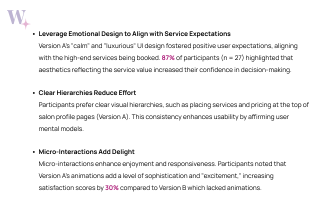
Through strategic UX and brand refinements, Wellfaced reduced sign-up drop-off rates by 25%, increased perceived trustworthiness by 40%, and boosted booking confidence for 87% of users. Aesthetic improvements, including luxury-inspired UI and micro-interactions, led to a 30% higher satisfaction rating, while clearer hierarchy and navigation refinements cut task completion time by 18%, making service discovery faster and more intuitive (Irby 2024).
Follow me on other channels
Follow me on other channels
Follow me on other channels